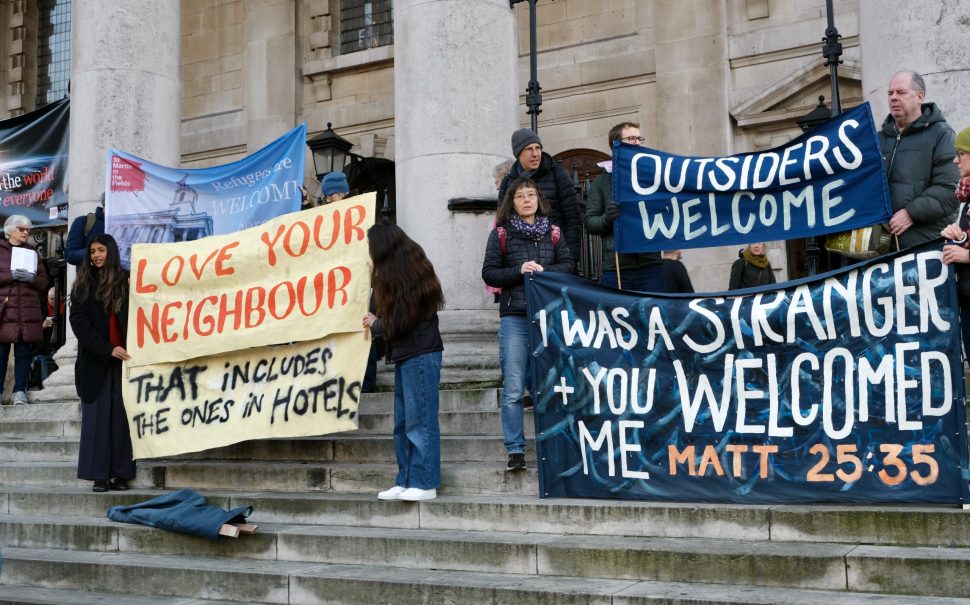
Churchgoers held a live Nativity service on Trafalgar Square to share messages of peace and inclusion before Tommy Robinson‘s Christmas carols event.
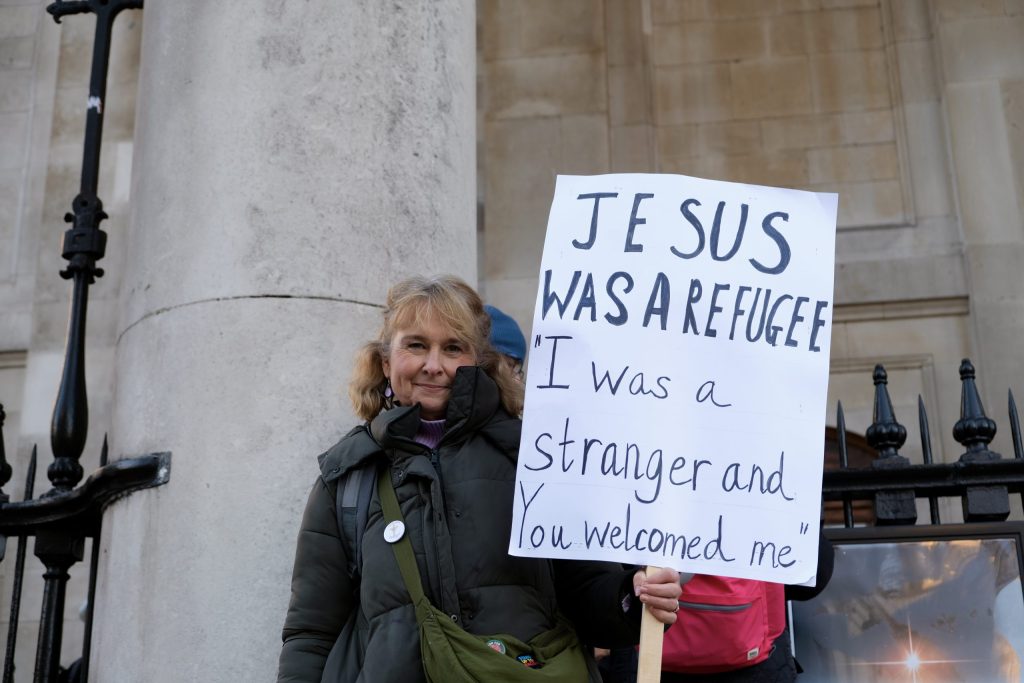
Religious leaders and congregations from across London gathered on the steps of St-Martin-in-the-Fields Church with banners of support for migrant communities before Robinson held an event claiming to ‘put Christ back into Christmas’ on December 13.
The gathering was a response to what church leaders have called a misuse of Christian language and symbols by far-right groups to ‘apparently justify racism and anti-migrant rhetoric’, according to a statement by Bishops in the Diocese of Southwark.
Reverend Dr Sam Wells, Vicar of St-Martin-in-the-Fields, said: “It seems clear that the far-right movement in this country at the moment is interested in an agenda by which this country becomes white again.
“It’s not my place to tell people they’re not Christians, that’s between them and God.
“But I do think that I have a very different opinion of what Christianity represents from the people that will be at this event.”
The focus of the gathering at St Martin’s was not to confront Robinson’s event, but to serve as a reminder that the Christmas story is about migrants, Revd. Wells said.
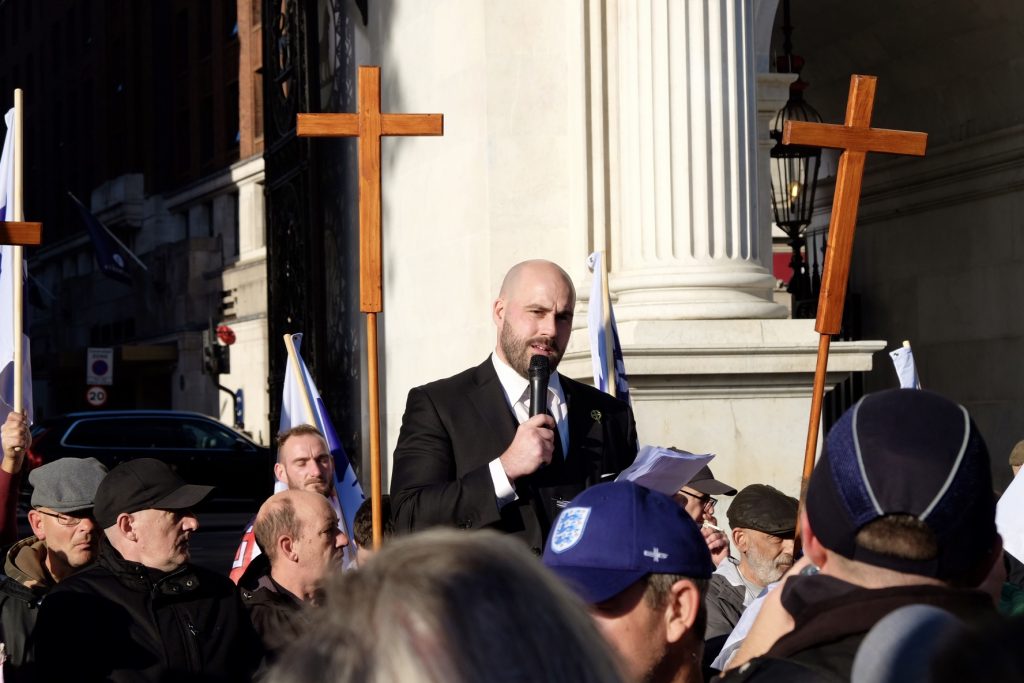
Robinson (real name Stephen Yaxley-Lennon) organised the event under the banner of ‘Unite the Kingdom’, which rose to prominence after a protest was attended by an estimated 110,000 people in September.
On December 13, around 1000 people attended the Unite the Kingdom carols service in Westminster, marking a sharp decline since September’s march.
Despite Robinson claiming that the carols event was not a political protest, the Met Police imposed conditions on where the group could gather.
Robinson said on X: “This event marks the beginning of a new Christian revival in the UK – a moment to reclaim and celebrate our heritage, culture and Christian identity.”
Organisations such as the Joint Public Issues Team (JPIT) – a partnership between the Baptist Union, the Methodist Church and the United Reformed Church – expressed concern that advertising for the event included anti-refugee and racist rhetoric.
Alex Clare-Young, JPIT campaigns and church engagement officer, said: “We’d reject the idea that Christ has been taken out of Christmas by anyone.
“The concern is around messaging that doesn’t feel authentic to the Christian faith and doesn’t feel loving.”
As well as being a visible part of Robinson’s previous Unite the Kingdom march, other far-right groups have used Christian symbols widely in their protests.
At a UKIP protest in October called ‘The Mass Deportations Tour’, UKIP leader Nick Tenconi stood behind a banner stating ‘Islamist invaders not welcome in Britain’ outside London Oratory Cathedral while surrounded by supporters holding crosses.
Revd. Wells said: “It seems to me that people marching are cultivating a culture of fear, and the picture of this country they’re portraying is not real and is highly undesirable.
“I don’t want to go back the 1950s. They may think it was a great white decade. I would call it sexist and racist.”
The Vicar says that many in his congregation feel threatened and bewildered by the far-right’s use of Christian symbols.
He said: “Our congregation is immensely diverse in gender, race, caste, sexuality, age, and all sorts of different designations, and we’re much the richer for it.
“We just have to be better at receiving the gifts that we’re being sent, and the worst thing to do is just to throw people out.
“There is no justification for using Christianity in that kind of agenda.”
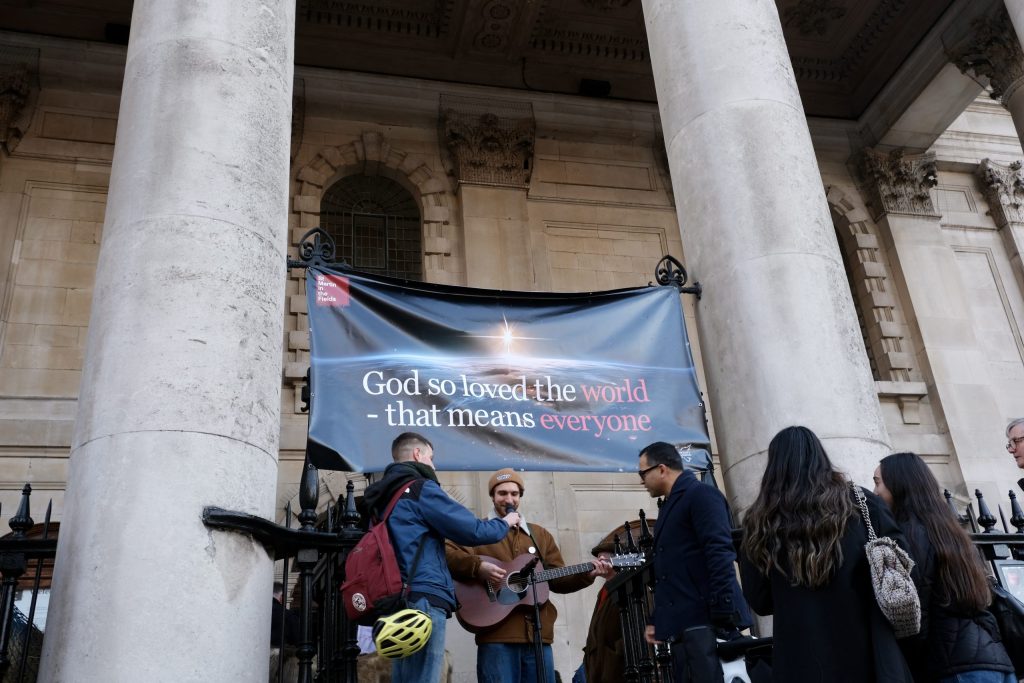
The JPIT has published resources for churches to use over the Christmas period which promote ‘love for all our neighbours’ and resist agendas of division and hostility, according to the organisation’s website.
The Church of England has also launched a poster campaign featuring slogans such as ‘Outsiders welcome’ which will be displayed at bus stops over December.
Featured image credit: Hamish McCorriston
Join the discussion