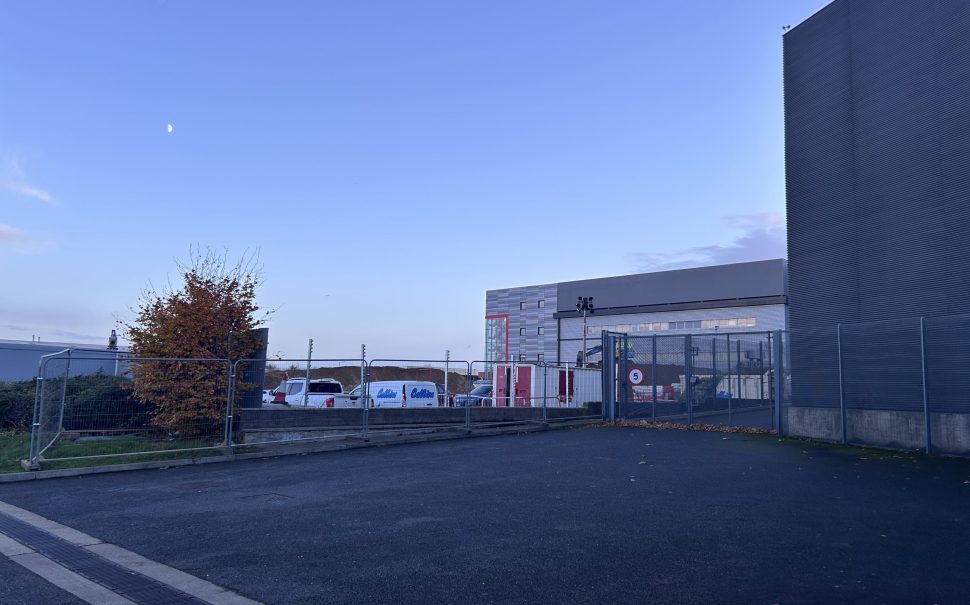
Dubbed the “data centre capital” of the UK, Slough – a town to the west of London – has become the focal point for growing unease over the expansion of the AI industry across the area.
From concerns regarding local water and energy supplies to more existential anxieties, residents are increasingly questioning the cumulative impact of so many facilities concentrated in their communities, particularly when many feel they were not adequately consulted before their construction.
Now, all across West London, campaigners are calling for greater transparency and research over the developments happening on their doorsteps.
The data centre capital
Home to 40 data centres, and second only to Virginia in the United States for the highest concentration of data centres, Slough is considered by locals as something of a testing ground for the infrastructure build-out – but now they are fighting back.
On 15 November, campaign group Slough Against Data Centres hosted an assembly at the London Heathrow Hilton, where residents shared their views on the buildings, alongside talks from advocacy experts.
The event coincided with a milestone for the campaign, whose petition calling on Slough Borough Council to pause new data centre developments had just surpassed the 1500 vote-threshold needed to force the council to debate a moratorium.
The petition calls on Slough Council to “pause new data centre developments in our town, including Microsoft’s proposed data centre next to Langley Train Station”, and cites concerns including pressure on local water and energy supplies, as well as long term health effects due to air pollution.
Dr Ambily Banerjee, founder of Slough Against Data Centres, said: “Our petition says that we as residents shouldn’t be the ones collecting the evidence.
“That someone, somewhere has approved all of these 40 data centers, and not a single cumulative assessment has been undertaken to see what is the risk of clustering so many in a small area.
“I would like the government to invest to make sure that we understand: what are the air pollution levels? What are the consequential health impacts? What is the impact on water pollution and on drinking water? What is the impact on our electrical grid?
“We need to bring it back to the tangible impacts on residents, that requires research to be funded and the results looked at before we blindly support more and more build-out of these hyperscale data centres.”
The Financial Times reported on 27 October that Slough Borough Council had written to data centre operators to request “visible quick wins” for the community, although Slough Against Data Centres told the North West Londoner that it had had no engagement with the council or developers about what form these might take.
A representative from Slough Council said that they were mindful of the potential environmental impacts of data centres within the borough, and pointed to an improvement in air quality in the area, despite the increase of facilities.
Among the event’s panel discussions and breakout workshops, the theme of transparency among the residents came up consistently – transparency regarding the health and environmental impacts, but also of the existence of the data centres themselves.
Dr Banerjee said: “If you become the second biggest hub in the world, and the local community has no clue, there’s something wrong with that.
“How have they consulted the local communities? Because most residents don’t even know.”
Not just Slough
While Slough’s reputation as data centre capital may have garnered more national attention, data centre creep has begun all over West London.
NW10, spanning the Park Royal and Harlesden areas, already has 10 data centres operational, with a further two planned, according to mapping from grassroots campaign group Stop NW10 Data Centers.
Residents expressed similar concerns regarding the health and environmental impacts from construction dust and diesel backup generators, which release NO₂ and nitrogen oxides – classed as a Group 1 carcinogen by the World Health Organisation.
Jonelle Awotwi, a resident concerned about the impact of the data centres, noted the proximity of the sites to the A406 North Circular Road, which already contributes to air pollution and breathing problems.
Brent Council’s air quality monitoring for 2025 showed annual mean NO₂ concentrations below national air quality targets.
As with Slough, there is a feeling here that data centres have been forced upon residents without much consultation.
Awotwi said: “I feel like the government and developers feel like these are communities that won’t be able to mobilise…because they are already overlooked so much.
“You wouldn’t see a data centre in Kensington, you wouldn’t see a data centre in the eyeline of Parliament.
“We also deserve to have long, healthy lives.”


Join the discussion