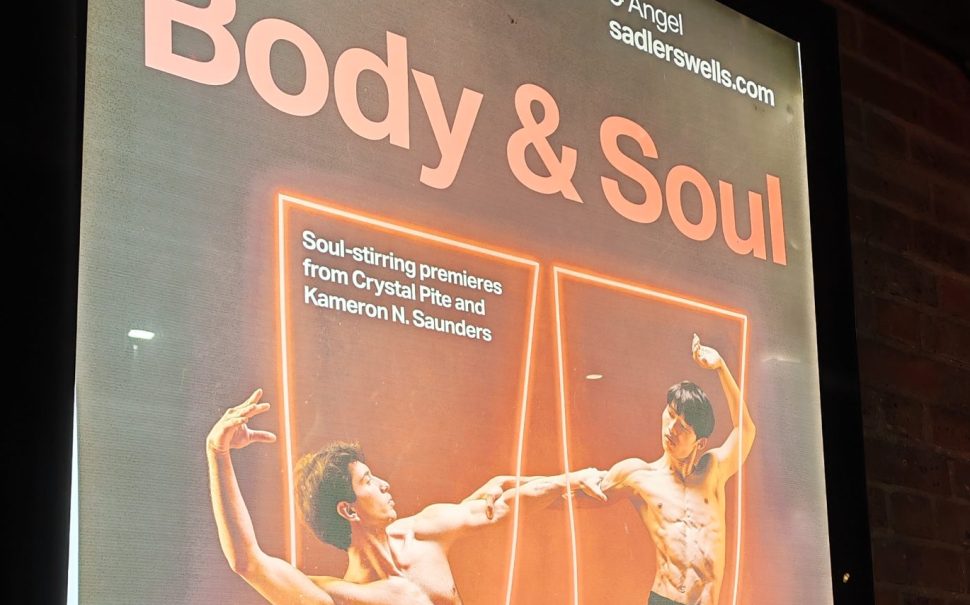
Taylor Swift’s viral backing dancer is premiering his work in Islington alongside a renowned choreographer in the English National Ballet’s newest double-bill Body & Soul.
Kameron N Saunders, who performed on The Eras Tour, is loved by fans worldwide after videos of his Bejeweled solo and line in We Are Never Getting Back Together – which he changed each show to match the dialect of each country and city – took over social media.
This, however, is his choreographic debut in the UK, and the dichotomy of the two pieces featured in this new production at Sadler’s Wells is curious yet captivating.
Saunders and choregrapher Crystal Pite share a humanistic choreographic style and both explore human themes in their pieces.
However, it is brave for anyone to be placed alongside Pite’s work as she is a true master of her craft.
The Canadian is renowned for tackling social issues.
Her pieces often feature meticulous metamorphosis of large androgynous ensembles using pedestrian-like movement and repetition too, while she also regularly uses expressive articulation to voiceovers rather than just a musical score.
Body & Soul Part 1, which premiered as the first section of a three-part ballet for Paris Opera Ballet, employs all of Pite’s usual techniques to explore the theme of conflict between groups of people, organisations and individuals.
Dressed in black long coats and work clothes similar to the commuters on the streets outside Sadler’s Wells, the audience is first introduced to a couple spotlighted on the stage, taking stage directions in French, from a godly voice similar to Pite’s work The Revisor.
Precise gestural movement perfectly in time with the voice is engrossing and it is almost unbelievable the voice and movements are two separate entities rather than being made by the dancer.
The piece goes on to explore the repetition of the stage directions in various iterations, each time with new dancers creating new sequences, new narratives and new opportunities for audience interpretation.
These duets are interspersed with the larger group patterns which mirror that of Flight Pattern – structures made of bodies which continually form and break, and a push and pull with a pulsing intensity which is hypnotic to watch.
The ensemble is reminiscent of an army. The dancers have a heaviness in their demeanour and yet a lightness and grace in the more virtuosic moments.
As an audience member aware of Pite’s work it is reassuring to take your seat in the theatre knowing whatever comes will be powerful and seamlessly executed.
It is easy to be enchanted by her choreography, and the only disappointment was when the interval arrived and the spell was broken.
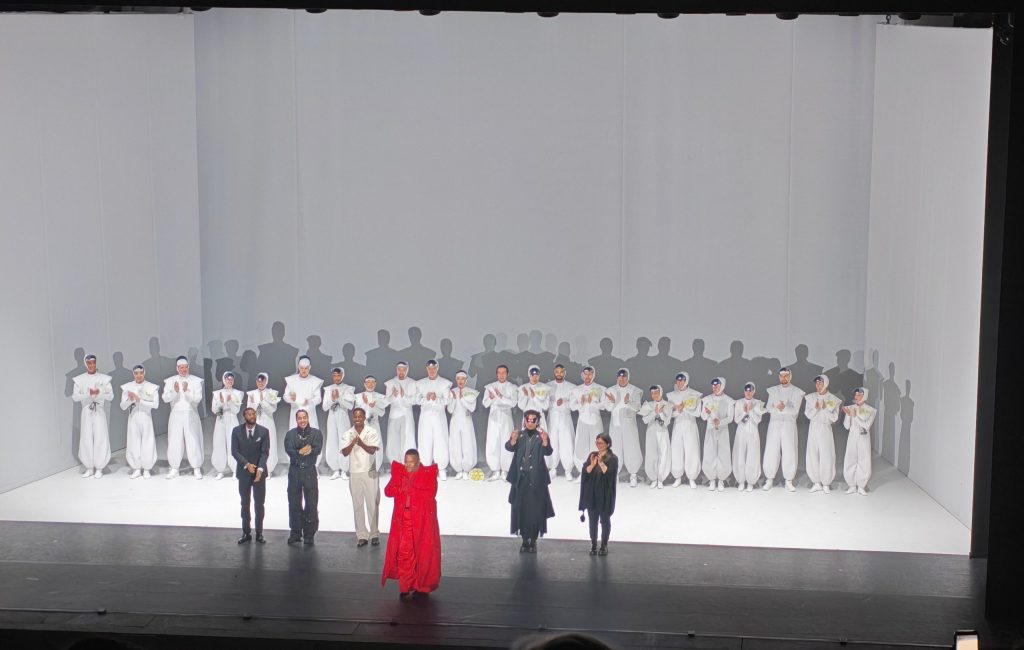
Then came Saunders’ premiere and the theatre was transported to a different world entirely.
His flamboyance is evident in the opening of Proper Conduct, but his three-part ballet exploring the expectations of societal gaze otherwise came as a surprise.
With a robotically voiced narrator as the thread between the sections, Saunders also uses gestural articulation to a voiceover, which is bemusing at times.
The first section is truly joyous and here he makes use of the ENB’s classical prowess.
It is buoyant and colourful with movement vocabulary reassuring to regular ballet audience members, fused with hints of African dance styles.
This is quickly broken down with the narrator explaining: “Beneath lies chaos, corruption and decay.”
The dancers strip down to nude underclothing to create scenes of entangled bodies. Here, though, I fear the meaning was lost- was it debauchery? Sexual exploration? Disease?
This section also did not make enough use of the incredible technique and athleticism of the ENB dancers, and felt like a slight waste of stage time and their skill.
Thirdly, we were treated to something more dystopian – a team of futuristic suited almost mechanical dancers with clean lines, a monochrome set and robotic movements.
It was a spectacle for the eye and perhaps the most innovative part of Saunders’ creation
Coming after Pite’s work, Proper Conduct did not seem to have quite the gravitas, flawless flow and clear messaging of her first half – which was, admittedly, a tough act to follow.
Putting a relatively new choreographer alongside such an established one did point out some of the weaknesses, and highlighted how Pite does not rely on extravagant costuming or set changes to create highly compelling and progressive work.
All she needs is an empty stage and a cast which is just as dramatically eloquent and technically beautiful as the ENB.
This is unlikely to be the last we will see from Saunders, though, as his work had hints of genius. Perhaps just longer is needed to refine his craft.
It is no mean feat debuting in the UK on a stage like Sadler’s Wells. He can be proud to be partnered with an icon like Pite, as can the Swifties who rightfully idolise him.
Body & Soul runs at Sadler’s Wells London until 28 March.

Join the discussion