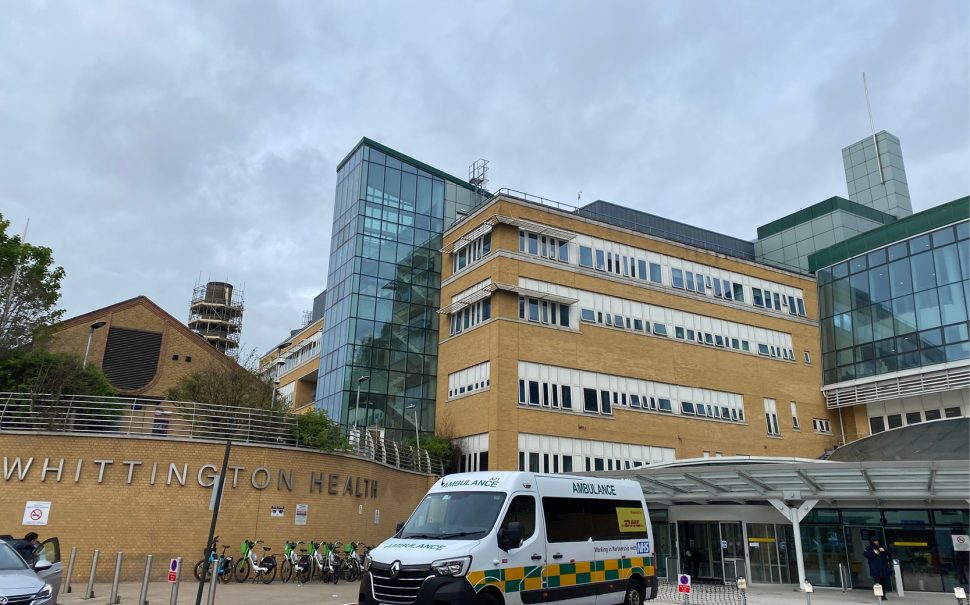
A community petition to dissuade Whittington Health NHS Trust from adopting the Federated Data Platform (FDP) built by Palantir has reached 2000 signatures.
The petition was set up by campaign group Defend the Whittington Hospital Coalition (DWHC), led by Shirley Franklin, and highlights ethical issues associated with the US-based software company.
NHS England contracted Palantir to create an AI platform to improve data connections across the organisation in 2023, although individual NHS trusts retain the authority to accept or reject its use.
Franklin said: “It’s about how brave they are.”
Palantir has faced criticism over ties to the Israeli Defence Forces and US Immigration and Customs Enforcement (ICE), along with its management of sensitive health data.
NHS trusts in Manchester and Leeds have opted to use custom-built systems which they claim are more productive than the FDP.
Duncan McCann, head of tech and data at Good Law Project, said: “Trusts and chairs have a responsibility to their patients, to their local community, to make the right choice… not just the expedient choice that’s being pushed.”
On trusts’ power to decline use of the FDP, he added: “It’s not just a theoretical possibility, it’s a real thing and it has actually happened.”
The FDP is free to NHS organisations, and McCann conceded Whittington Health would be left with a difficult choice over whether to adopt it due to the cost of alternatives plus soft pressure from NHS England.
A spokesperson for Whittington Health NHS Trust said no plans had yet been made to roll out the FDP.
They added: “We are aware of concerns about the involvement of some of the platform’s partners and will be mindful of them as well as the potential benefits that the system could bring for our patients as we continue consider the issue.”
Having campaigned nationally against Palantir for years, McCann praised the DWHC’s community-led petition.
He said: “It is so important that trusts hear this organic noise coming from their patients.”
On 25 March, McCann and the DWHC spoke to the Whittington Health board and presented the petition, and McCann has been invited to speak again.
He credited the DWHC and their decades-long relationship with the board for securing the meeting.
Other campaigns run by the Good Law Project, including those against X and Meta, prioritise nationally coordinated petitions, but McCann explained local campaigns were making more of an impact on the Palantir issue.
He said: “There’s this real philosophy of letting a thousand flowers bloom.
“There’s so much energy and excitement – you can point to all these different initiatives, all running in parallel – it just shows the strength of feeling.”
Similar campaigns to dissuade trusts from adopting the FDP, including Homerton Healthcare NHS Foundation Trust in Hackney, have faced more resistance from boards.
George Binette, who led the Homerton campaign, said: “We were taken to task by some elements of the senior management who completely misrepresented the protest … a very different reception to at the Whittington.”
A Homerton Healthcare NHS Foundation Trust spokesperson said the trust had engaged with residents and campaign groups, including via public meetings and written correspondence, and would continue to listen to views.
Binette’s campaign group have also been working with trade unions, Health Workers for a Free Palestine, and their Unison branch, and have sent over 500 postcards to the hospital’s board in place of a traditional petition.
An NHS England spokesperson claimed the FDP has already delivered benefits for patients and the organisation such as joining up care, speeding up cancer diagnosis and ensuring thousands of additional patients can be treated each month.
They added: “[Palantir] was appointed in line with public contract regulations and must only operate under the instruction of the NHS, with all access to data remaining under NHS control and strict contractual obligations protecting confidentiality.”
A Palantir spokesperson claimed their software had led to 110,000 additional operations, a 15% reduction in discharge delays, and 7% faster cancer diagnoses.
They added: “It is our belief that every major government infrastructure programme of this scale and importance should be held under constant review and scrutiny, with suppliers held fully accountable.
“When you look at this programme, what you find is one of the rare examples of technology genuinely delivering in government.
“Our software is producing real, measurable results.”
Featured image credit: Jess Winstanley




Join the discussion