
Nicotine pouches — small, tobacco-free sachets placed discreetly under the lip — are rapidly becoming one of the UK’s fastest-growing nicotine products.
Sold in sleek, circular containers, they are promoted as being a tobacco-free, cleaner alternative to smoking.
As sales surge and promotion intensifies, public health campaigners have begun to speak out. Given the highly addictive nature of nicotine, various organisations suggest this may just be the tobacco industry’s latest attempt to preserve a declining customer base.
Eve Taylor, a research fellow from UCL’s Department of Behavioural Science and Health explained: “Use has increased a lot over the past 2 to 3 years. We’ve seen quite a big increase, but use is still quite low.”
A fast-growing market
An industry valued at $7billion by Bloomberg, nicotine pouches have seen UK sales volume climb annually since their introduction.
Estimates from Tobacco Insider have placed nicotine pouch sales at £188 million for 2025, the products have seen a steady uptick since 2019, when they first became widely available across Europe.
Despite rising sales volume and market value, the products’ usage statistics still remain low—for now. In a study conducted by King’s College and Action on Smoking and Health (ASH), research found that the prevalence of adult ever and current use in the UK doubled from 2020 to 2024, reaching 5.4%.
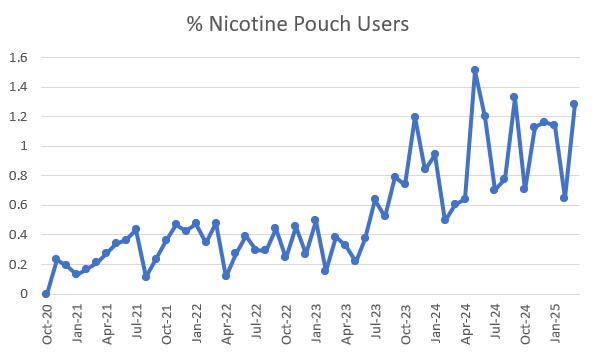
Source: Oral nicotine pouch use in Great Britain: a repeat cross-sectional study, 2020–25
Although the numbers may not appear large at first glance, with roughly 53 million adults in the UK, the 1% that currently use nicotine pouches regularly represents 530,000 people. The 5.4% that report having tried nicotine pouches equates to almost 3 million people. In countries like Sweden, where pouches have been on the market for longer, around 20–30% of young men use the products.
The same ASH study found use of nicotine pouches to be highest among younger adults, particularly males under 40. Among 18-34 year-olds, usage rates are notably higher than in older age groups.
While growth has been rapid, regular use remains relatively uncommon. “It’s around one percent of people currently saying they use nicotine pouches,” Taylor said. “That’s gone up from 0.1% around 3 years ago. So we’ve seen a dramatic increase, but it’s still around 1%.”
Concerns are most concentrated on increases in teenage use of oral nicotine pouches. As the products contain no tobacco, they are only subject to general consumer product safety regulations. This means that they are currently legal for children to purchase. Similarly to vapes, the choice of flavours and marketing tactics have also drawn criticism as potentially appealing to children.
Nicotine itself is not the substance most responsible for the cancer risk posed by smoking cigarettes. For this reason, it is not currently covered by UK laws addressing tobacco and vape products. While the oral pouches have not been linked to future health risks, public health campaigners point towards the highly addictive quality of nicotine, and its potential for habit formation.
“Nicotine is an extremely addictive substance,” Taylor said. “We want to make sure that they are available to people who smoke because that might be a way that they quit smoking, but we don’t want people who have never used nicotine to start using nicotine because it is an addictive product.”
Caroline Cerny of Action on Smoking and Health believes the products’ appeal to teenagers and young people is not coincidental. She said: “It’s not that nicotine is marketing itself to children. It’s that the tobacco industry is continually finding new ways to keep nicotine products on the market.”
Following a familiar pattern
The biggest brands in stores across the UK are not new entrants to the market—their parent companies have been operating here for over a century in some cases. Popular brands like Velo, Nordic Spirit and ZYN represent a growing part of the product portfolios of major tobacco multinationals.
As the number of smokers has fallen—adult smoking is at a historic low in the UK—tobacco companies are pursuing increasingly aggressive advertising efforts to promote alternative nicotine products.
For critics, the pattern is cyclical: as soon as one product becomes restricted, another is launched.
Nicotine pouches currently occupy a regulatory grey area. Due to their lack of tobacco content, they do not face the same advertising and packaging constraints as cigarettes. As a result, companies may promote these products with relative flexibility.
Researchers say this regulatory gap emerged largely because the products fall outside existing categories. “Because this is a nicotine only product and it’s not inhaled or combusted, they basically managed to loophole all of the regulation that currently exists,” Eve Taylor explained.
One area of their promotional activities that has drawn particular concern from campaigners is the distribution of the pouches as “free testers” in supermarkets and at music festivals. In these cases they are given out indiscriminately—with no attempt to ascertain whether the recipient is already a smoker or not.
“It’s the last hurrah,” Cerny said. “They [tobacco companies] know the Tobacco and Vapes Bill is coming, so they’re trying to build the biggest possible market before the rules change.”
Harm reduction or market expansion?
The debate around nicotine pouches is similar to that of vapes when they were first introduced: does this less harmful form of nicotine use offer smokers a resource to quit, or is it simply a clever way for tobacco companies to maintain profits when legislation tightens?
The difference largely comes down to how the products are used. “It will be substantially less than smoking because there’s no tobacco and there’s no combustion,” Taylor said. “It doesn’t have any of the carcinogens in it that a smoking cigarette would.”
On the other hand, distributing free testers at music festivals raises the question of whether the pouches are intended to substitute smoking—or to expand nicotine use to a new demographic.
Public health experts say the challenge for policymakers is balancing harm reduction with prevention. “It’s a really delicate messaging act that you have to do,” Taylor explained.
“Unlike with smoking, where you regulate everything bad and tell everyone it’s awful. But with these other products, you have to do a careful balancing act, because they might save the life of someone who smokes if they switch to these other products.”
The money behind nicotine pouch advertising
Two separate FOI requests from November 2025 and February 2026 illuminate the advertising push being made on these products. By 2023/24 the “Tobacco and Accessories” advertising category on the rail network —which includes pouches— generated more than £570,000 in gross revenue. In the current financial year, nicotine-related categories across rail and bus shelters have already brought in over £1.1 million. Where nicotine pouch advertising on London buses is concerned, however, disclosure is far less transparent. Listed under “Pharmaceuticals”, it is impossible to determine how much of the revenue is accounted for by pouches alone. Before their current contract, reporting on nicotine advertisements under the “bus shelters” category was not required, leaving the data until April 2025 completely blank.
A keyword search on Google’s Ads Transparency Centre reveals the scope and advertising tactics being employed by these brands. While Google only provides approximate figures for non-political advertisements, key industry players such as Nordic Spirit and Velo have all-time ad volume listed at ~600 and ~500 respectively. Further delving into the content of these advertisements, lifestyle imagery is extremely commonplace. Branding rarely promotes the pouches as smoking or vaping alternatives, rather as a product to be “enjoyed.”



The legislative response
With the proposed Tobacco and Vape bill on the horizon, the marketing flexibility enjoyed by nicotine pouch companies is set to change.
Under the legislation, broader categories of nicotine products will come under regulation—rather than naming individual items. This seeks to close any loopholes that have previously been exploited by modifying products to shift them out of prohibited product types.
Researchers say the new regulatory approach is designed to prevent similar loopholes emerging in future nicotine products.
With its central aim of creating a “smoke-free generation”, the bill will introduce a ban on selling tobacco products to anyone born after 2019. Supporters are hopeful that its broader drafting will “future-proof” regulation against any further iterations of nicotine innovation.
In addition to clamping down on nicotine marketing, the legislation proposes stricter enforcement mechanisms, including retailer licensing. These measures would seek to suppress underage sales and illicit trade.
A crossroads moment
Nicotine pouches only account for a small portion of nicotine use in Britain. Now, with aggressive marketing, increasing growth, and ownership rooted in the same corporations that dominated cigarette sales for decades, this may only continue to increase.
Whether nicotine pouches serve as a means to quit smoking, or as a route toward lifelong addiction may depend less on the product, and more on how effectively policymakers respond.
Public health researchers say the key concern lies not only in the products themselves, but in how they are marketed. “Nicotine is highly addictive,” Taylor said. “They should not be marketed and sold in the way that they currently are.”
As the Tobacco and Vapes Bill moves forward, the UK faces a familiar challenge: how to reduce harm without allowing history to repeat itself in a new, more discreet form.
Feature image: Rob Warner on Unsplash




Join the discussion