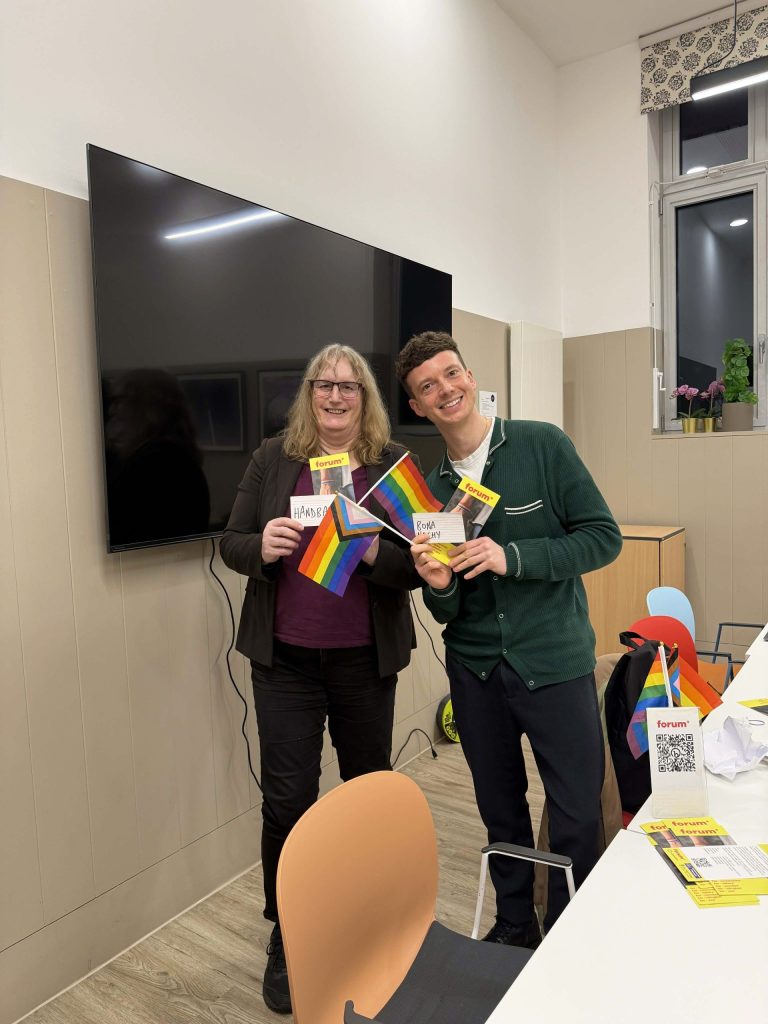
A secret queer language was brought to life at a workshop held by forum+ at Luke’s Community Centre in Islington as part of LGBTQ+ History Month.
Dan de la Motte, a 35-year-old performer specialising in queer heritage, taught a workshop on the underground language Polari, which combines Yiddish, Cockney rhyming slang, Romani and languages from Eastern Europe.
Spoken in the streets of London as early as the 17th Century, Polari formed out of necessity to help foster a safe space for gay men.
De la Motte said: “They were still ready to say, ‘no, this is who we are – we are cheeky, we are playful, we are powerful, and proud, and strong.’
“It’s also gallows humour – ‘I’m speaking this language so I don’t get beaten up, so I don’t get arrested, but that doesn’t mean I can’t be playful with it.'”
Meant to be understood by only some members of society, Polari evolved out of cant – or thieves’ cant – and other slang vocabulary to become a flirty, playful language which remained just out of reach for those not in the know.
Yet many words in use today come from Polari such as ‘naff’, meaning rubbish or uncool, which was originally the acronym for Not Available For F******, or unattractive.
Polari was first brought into the wider spotlight through the BBC Radio’s Round the Horne comedy series which featured Kenneth Williams, in his role as Sandy, often joking with innuendos and double entendres.
De la Motte said: “That’s the power of Round the Horne on BBC radio in the 1960s.
“The entire family is roaring with laughter, but they don’t know what they’re laughing at.
”If you’re part of the family, you’ll know what I’m rabbiting on about – rabbit and pork, rabbit-talk.”
Despite its contemporary use, Polari started to decline by the early 1970s, as attitudes shifted towards being more open about one’s sexuality.
De la Motte said: “The reason why Polari became seen as problematic was because it was highly camp, and at this time, the new wave of students in the early 1970s wanted to be more militant with their activism.
“That doesn’t necessarily exist at odds with Polari at all, but what they saw in the [United] States was that the activism didn’t feel like it was hidden, like it was cloaked.”
The secretive nature of Polari was a way of hiding in plain sight and keeping people safe at a time before homosexuality was decriminalised in the UK, too.
The quintessentially British humour and cheekiness of Polari, as well as the inside jokes outsiders aren’t meant to get, means the underground language remains as a source of pride for some in the LGBTQ+ community.
De la Motte said: “There is power in the fist and the limp wrist.”
Workshop host forum+ is an independent charity which provides support for LGBTQ+ community in and around Camden and Islington.
They host social support groups across north west London which aim to help strengthen the community and provide support for anyone seeking help.
Forum+ director Tessa Havers-Strong said: “At forum+ we pride ourselves in having a deep knowledge of our local area and we’re always delighted when we can collaborate with great community groups and spaces.”
“Not only are our social support groups fun but they are also about building confidence, connections and acquiring skills, it’s always exciting creating new activities and events.
“We enjoy regular groups like Cooking With Pride at St Luke’s and Rainbow Paddlers at the Pirate Castle in Camden, we garden together near King’s Cross and kayak on the Regents Canal.”
To learn more about forum+, visit their Instagram page.
Feature Image: forum+

Join the discussion