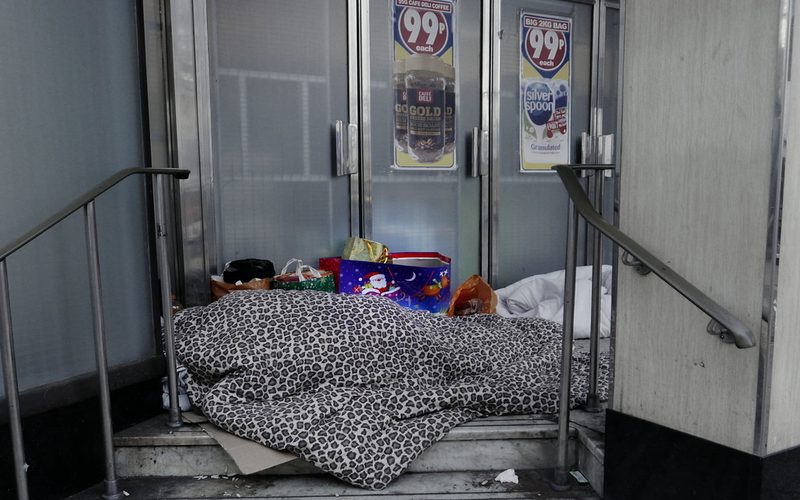
London boroughs have seen the number of households placed in temporary accommodation reach an all-time high, with rising rates of homelessness placing extraordinary pressures on local councils and families.
There were almost 75,000 households in temporary accommodation in London as of June 30 this year, the latest government figures show.
This is the highest figure ever recorded and represents more than half (56%) of all households in temporary accomodation nationally.
The issue is particularly acute in the capital, with a figure 370% higher than the second-highest English region – the South East – despite London having a lower population.
Local authorities have a duty – under the Housing Act 1996 – to provide temporary accommodation to people who are homeless or at risk of homelessness if they are deemed vulnerable and in priority need.
A recent London Councils report suggests that, because of annual increases in homelessness rates, London boroughs face an estimated £740 million funding shortfall for temporary accommodation and are on the brink of bankruptcy.
This is due to the scale of homelessness in the capital, which has meant that boroughs do not have access to enough local accommodation to cover the demand.
Councils are increasingly having to rely on accommodation from private suppliers – which has led them to spend the equivalent of 11% of every household’s council tax bill on temporary accomodation alone.
Research by the London School of Economics revealed that eight London boroughs spent a combined £543 million on temporary accommodation in 2024/2025.
It suggests that the financial burden has been worsened since the government’s housing benefit subsidy – previously supplied to reimburse councils’ temporary accomodation spending – was frozen in 2011.
Newham currently has the highest number of households in temporary accomodation at 7,137, with Westminster and Southwark following at 4,449 and 4,117 respectively.
In a cabinet meeting held last month, Newham Council described the situation as a ‘housing emergency of unprecedented scale’.
Director of Housing Needs, Zulfiqar Mulak MBE, said: “This is not merely a local crisis, but a symptom of a wider national housing market failure: spiralling private rents, a shrinking supply of genuinely affordable homes, landlords exiting the sector, and a continued freeze on Local Housing Allowance (LHA).
“Across London these pressures are pushing more families into homelessness and driving demand for TA to unsustainable levels.”
These concerns were echoed by Southwark Council in a statement made to The Londoners.
Councillor Helen Dennis, Cabinet Member for New Homes and Sustainable Development, said: “With £4m being spent every day on temporary accommodation by London Councils, it’s clear that we need urgent action and a shift towards prevention.
“Building more social rent homes is the only long-term solution to this crisis.”
They stated that they are currently building 3,000 new council homes and adopting new strategies on homelessness and rough sleeping in response to the crisis.
As councils struggle to finance accomodation, vulnerable families have been forced to suffer on waiting lists or compromise on their living conditions to remain sheltered.
Two-thirds of London households in temporary accomodation include dependent children, and a significant proportion of these households are composed of single female parents with dependent children.
This demographic is the most highly represented, constituting a third of all households.
Within this demographic is Carlie, 35, and her six kids – many of whom suffer from disabilities – who have been in temporary accommodation supplied by Ealing Council for many years.
This month, she was forced to fight against being moved six hours away to County Durham with the help of the London Renters’ Union and was eventually moved to Kingston on 10 November.
Carlie said: “I feel stressed and tired. The rent is £750 a week and I cannot afford it.”
She fears that she will soon be left in arrears and described the negative toll that the move has taken on her mental health, often having panic attacks.
The new accomodation in Kingston is far from her mother, who she describes as her main support, as well as her children’s schools and hospitals.
One of her children suffers from liver disease and another with learning difficulties, while her youngest baby suffers from sickle cell.
The charity Single Homeless Project (SHP) suggest that Carlie’s case is far from unique.
Lucy Campbell, who has worked on women’s homelessness for more than 20 years, said: “We are seeing survivors of domestic abuse move miles away from all their support networks and mothers move miles away from their children’s schools.
“Unfortunately, because of the housing crisis, which is felt most acutely in London, that is not an unusual situation.
“Every year we see around 35 to 40% of women rough sleeping after having been in some form of homelessness accommodation.
“What they’re being given to resolve their homelessness is not working – it’s either not sustainable or it’s not suitable or safe.”
They suggest that factors like gender-based violence and abuse, the varied and hidden nature of women’s homelessness, and increased care-taking responsibilities have contributed to the over-representation of single mothers in TA.
Campbell added: “I have never come across a woman experiencing homelessness who hasn’t also been affected by some form of gender-based violence or abuse.
“They can go into temporary accommodation, but that doesn’t mean that that accommodation is suitable for the needs of them and their families.”
A spokesperson for the Ministry of Housing, Communities and Local Government said: “Everyone deserves a safe place to call home, and we’re taking action to fix the housing crisis in London and across the country.
“We are providing more than £400 million in homelessness funding for London this year, launching a cross-government homelessness strategy, and investing a record £39 billion in affordable and social housing.”
Ealing Council were contacted for comment.
Feature Image Credit: Alisdare Hickson, Flickr under CC BY-SA 2.0 licence.



Join the discussion