
Brent Council has been lobbying for gambling reform in the hope of improving high-streets and local communities.
The borough is one of the most economically deprived areas in London but has the largest number of gambling licenses in the capital outside of Westminster, according to data sourced from UK regulator the Gambling Commission.
Earlier this year, council leader Muhammed Butt led a coalition of councils and mayors demanding that local authorities should be given the power to reject and revoke gambling licenses in their areas.
A gambling license is equivalent to a shop or premises where people can place bets with bookmakers or play online games and slot machines in the hopes of winning money.
Brent has 78 gambling licenses, which compared with the latest Census data, is equivalent to one license per 4,500 people.
This number of licenses is more than four times higher than Sutton which has only has 18 and a ratio of one license per 12,000 people.
The average across London is 45 licenses per borough.
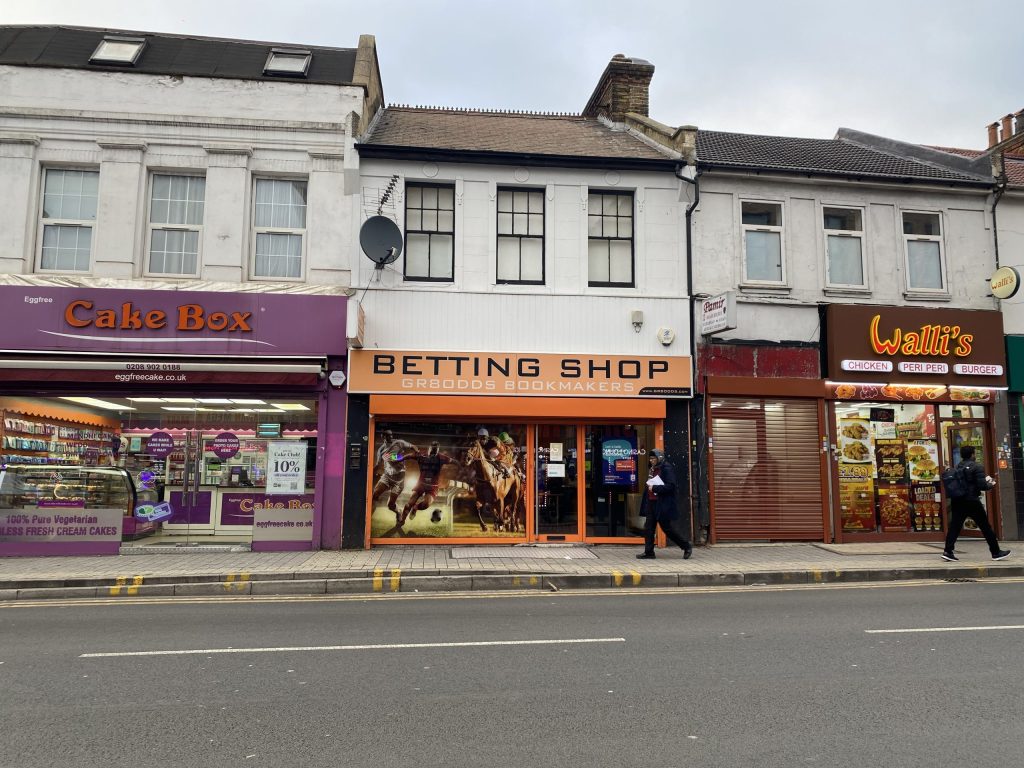
Within Brent, Wembley is a particular hotspot, with 27 licenses in total and 13 strung along Wembley High Road.
While visiting the road, one source told me that the demand in the area was well-known and the big gambling chains ‘strategically’ placed shops there.
A customer explained he was there ‘just for fun’ and only ever played up to £10, while another said ‘when I come in here it’s because I’m hiding from something’.
Gr8odds is one of the few independent gambling shops on the road, surrounded by Ladbrokes, Betfred, Paddy Power.
The shop’s owner, Richard Thomas, has been trading in Wembley for fifteen years.
Thomas said: “Many independent bookmakers, especially small operators with one to five shops are very much on a tipping point, with any drastic changes in tax or costs likely to be the end of their business and a loss of jobs to the employees.
“I wasn’t aware of Brent having the highest number of licenses but would think it’s a lot to do with the demographics.
“Obviously market factors will be important, if an operator has a successful shop in Wembley, they may open another. This has been the case recently with the proliferation of 24-hour Adult Gaming Centres.”
In November, the Gambling Commission suspended the license of Dead Heat Racing in Brent due to ‘suspected social responsibility and anti-money laundering failings’.
This was part of a small spree of three suspensions within the space of a few weeks, following no suspensions for more than a year prior.
Brent Council are lobbying for local authorities to be able to enforce suspensions themselves.
Thomas said: “Local authorities should have more powers to intervene. They have a very limited say if they want to stop a new licence and this is wrong in my view.
“If licences are not following licence conditions or are not adhering to policies, councils should be able to revoke such premises.”
In her Autumn Budget, Rachel Reeves increased tax on remote-gambling but spared high-street shops, following scaremongering from gambling firms that the industry provides significant economic contributions, necessary employment and facilitates communities.
In November, Rob Wood, wrote on behalf of the Betting and Gambling Council: ‘These shops are more than just locations to place a bet; they are integral parts of the communities they serve and vital components of the UK high street.’
Thomas said: “I would strongly agree with this statement as many of our customers purely come to socialise and, particularly for more elderly customers, this can be the only contact they have throughout their day.
“I also feel that a lot of UK high-streets have many empty shops. Having an open shop paying rent, rates and staff wages is far better than an empty shop or another charity shop paying reduced rates.”
However, a report from the Social Market Foundation, which was sponsored by Brent Council, into the impact of gambling venues on high-streets was published in October.
It used Brent as a case study and found that some residents viewed high-street gambling shops unfavourably and felt that their existence preyed on the vulnerability of poor residents hoping to win money to improve their economic situation.
Dawn Butler, MP for Brent East, wrote in the report: “As one of London’s most economically deprived boroughs, it has witnessed first-hand the clustering of gambling premises, the strain this places on local services, and the anxiety it creates among residents.”
Matt Zarb-Cousin is a former gambling addict and the co-founder of Gamban, a digital software designed to stop online gambling.
He said: “These [shops] are not drivers of economic growth, they are extractive industries that take money from areas and don’t give it a full lot back.
“Gambling is one of the lowest Gross Value Added (GVA) sectors which means, literally, money spent anywhere else is likely to drive more economic growth.
“It’s fairly easy to get a license and it’s difficult to revoke it. For me it’s an industry that needs to be constrained as much as possible and taxed properly to offset the economic detriment that it is causing.
“We’re starting to tax it more sufficiently now, which is great, but we’re definitely not regulating enough.”
Zarb-Cousin has collaborated with Brent Council and former Prime Minister Gordon Brown on gambling reform campaigns.
He argued that current legislation in the Gambling Act 2005 represents a period of ‘liberalisation’ in attitudes towards gambling which is now being reconsidered as gambling harms are better understood.
Zarb-Cousin believes gambling harm is sometimes simplified down to the vulnerability or susceptibility of an individual which understates the exploitative nature of the industry and its leading operators.
He said: “The industry is fundamentally built on the deception that you can win when you can’t. You can’t win long-term because it’s mathematically impossible.
“With sports or racing betting it’s possible to get an edge over the bookmaker, but only theoretically because if you do that they will just close or restrict your account.
“You have an adversarial relationship between the operator and the customer. If an operator is extremely cashrich, has significantly more resources, and has information on that customer, then the operator can harness very sophisticated techniques to get that customer engaged. It’s not a fair fight.
“An individual’s predisposition [to gambling addiction] is something we can’t regulate. What we can regulate is the products and practices of the industry and we can make sure that they are regulated to a point where harm is minimised and we’re nowhere near that point yet.
“The industry is deriving way too much of its profit from people with gambling problems.”
Featured image credit: Erik Mclean via Unsplash
Join the discussion