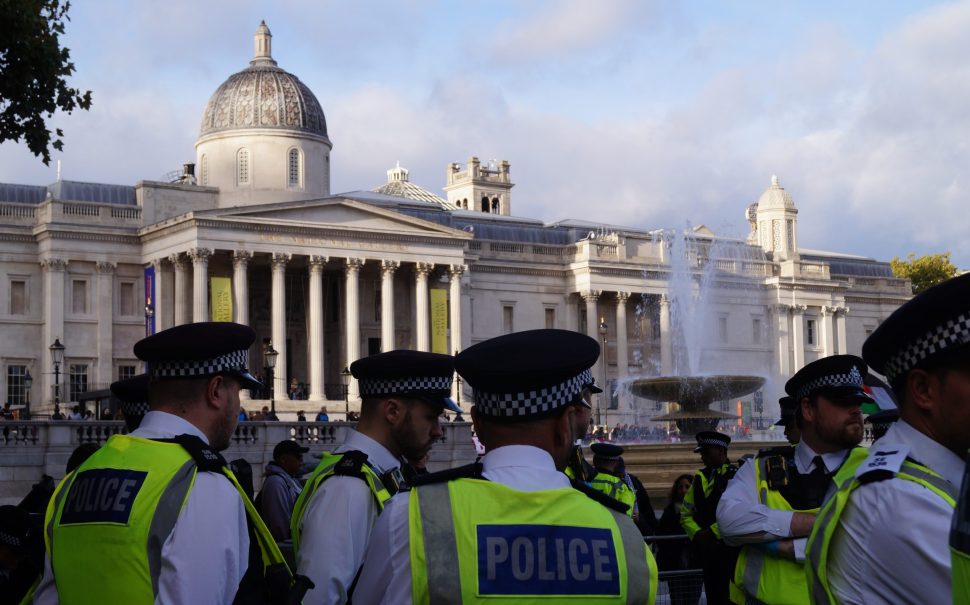
Nearly 700 Met police officers and staff are still serving, but off front-lines, despite facing ‘live’ allegations of sexual misconduct or domestic abuse, new information from the MPS has revealed.
As of September 2025, 346 officers continue to work within the Met despite outstanding claims of sexual misconduct, with a further 349 officers for domestic abuse accusations and this number is projected to increase by the end of the year.
Accused officers are removed from frontline duties but remain employed and are still privy to privileged police systems and information which campaigners have flagged as a fundamental risk to public safety.
Since 2020, the MPS has recorded 1,434 matters of sexual misconduct within the force – nearly half of which were for sexual assault – along with 1,374 cases of domestic abuse.
Ben Bradford, professor of Global City Policing at the Department of Security and Crime Science UCL, explained police-perpetrated abuse is uniquely dangerous because the public are not always aware when incidents occur.
He said: “Transparency is really important. There are people inside policing who would say ‘we’re always washing our dirty laundry in public’, but I don’t think they’ve got any choice really.
“They have to do it publicly and it has to be transparent because people need to know what is going on.”
Bradford further warned on the risks of power imbalance when abusive officers have continued access to the uniform.
He added: “If you’re engaged in coercive control of your partner and you’re a police officer, you’ve got a whole set of tools you can use that no one else can.”
Cases are recorded by the Met as ‘conduct matters’ if a complaint has been raised by members of the public, colleagues, or supervisors due to an officers on/off duty behaviour.
A High Court ruling earlier this year introduced new vetting regulations which ruled that officers cannot be dismissed solely by removing their vetting clearance, even in incidents of sexual misconduct and domestic abuse.
Under new law officers who fail vetting are put on ‘special vetting leave’ meaning they stay employed unless a criminal conviction is given or misconduct is proven.
A significant number of sexual misconduct and domestic abuse incidents have been found to occur on frontline policing – the department which has most contact with the public.
Over the last five years, 773 sexual misconduct conduct matters and 624 domestic abuse cases were committed by officers working on the frontline.
Andrea Simon, Director of the End Violence Against Women coalition, said: “There can be no place in policing for those who rape and abuse women.
“Perpetrators must be prevented from joining the police and there must be a lawful, robust and timely process to remove those who pose a risk to women and girls.”
Simon believes more attention should be given to victims and survivors of police-perpetrated abuse, and there needs to be more needs to be done to instill trust back into the public.
The Angiolini Inquiry, which was opened in 2021 by Lady Angiolini to investigate systemic failings behind the rape and murder of Sarah Everard, drew on evidence from whistleblowers on how internal misconduct flies under the radar.
Lady Angiolini is adamant there is not enough being done to protect women in public spaces, and the crisis of violence against women falls short in urgency to other high priority crimes.
Since 2020 male police officers and staff have composed 93% of sexual misconduct cases and 84% of domestic abuse allegations.
Angiolini said: “There are still many victims because there are still many perpetrators of sexually motivated crimes who escape detection and prosecution.
“Women should feel safer but do not.”
National research conducted by an internal investigations team found two-thirds of women aged 18-24 had reported feeling unsafe in public because of the actions of a man, and a survey conducted by the UN in 2021 uncovered 71% of women had experienced some form of sexual harassment in their lifetime.
Angiolini added: “Too many perpetrators are slipping through the cracks in an overworked system.
“Police, prison and probation resources are overstretched and underfunded and this is despite violence against women and girls being described as a national threat in the 2023 strategic policing requirement.
“Prevention in this [public] space remains just words.”
She further expressed more was being done on local levels to hold aggressors to accountability, and that violence against women could no longer ‘credibly be called a national threat’.
Whistleblower and ex Met police officer, Issy Vine, described the ‘rotten’ culture within the MPS alleging widespread misogyny and silence around misconduct.
She believes senior officers were often the worst offenders as they had a hierarchical belief of feeling the most important.
Vine told The Londoners: “I would say 30% of them are decent and then 70% are just awful people who make terrible jokes that others then just go along with.
“It’s like treading on eggshells everywhere because on the surface they seem really nice but underneath so many of them have a more insidious and aggressive nature.
“There’s an attraction to control and power – to constantly feel like you’re the most important person in the room.”
She claims internal reporting systems regularly fail victims, and recalled how her own complaint of misconduct was show to the officer she reported weeks before he was interviewed.
Vine also alleges the misconduct process focused more on protecting the reputation of the Met rather than the need to remove dangerous officers.
She added: “If it’s not as bad as Sarah Everard they treat it as though there’s room to give the officer a second chance.”
Since leaving the MPS Vine has been campaigning for Isabelle’s Law, proposed legislation designed to hold more police officers accountable in cases of misconduct.
Vine also has a TikTok account, @issyvine, in which she regularly uploads videos on her experience in the Met and offers support to other victims.
Featured image: Megan Norcott



Join the discussion