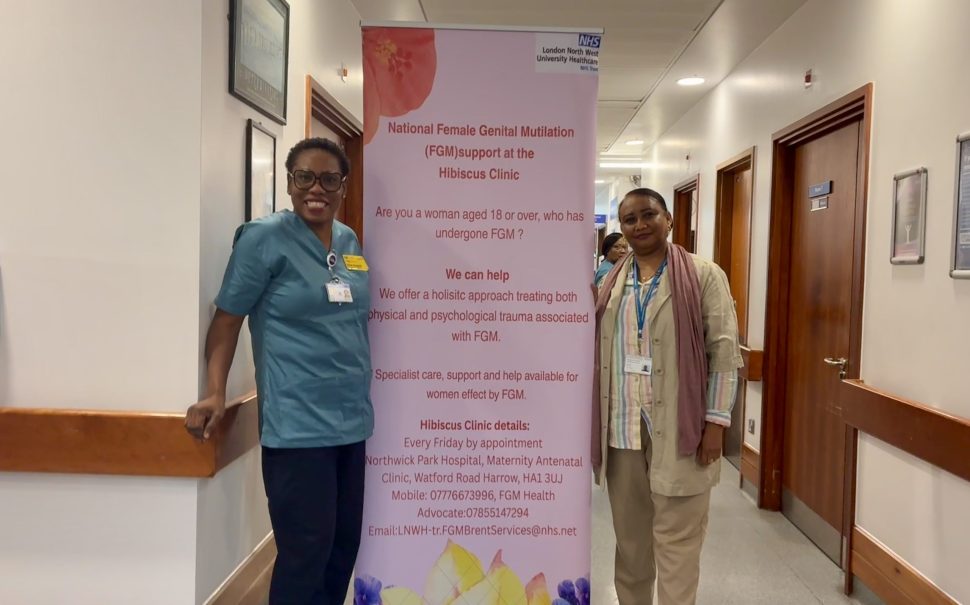
The number of newly identified Female Genital Mutilation (FGM) cases in Brent is nine times higher than the London average, NHS data shows.
FGM refers to the partial or total removal, or damage, of external female genitalia for non-medical reasons, and occurs in hidden cultural practices around the world.
Brent has consistently shown the highest levels of FGM identification in London for over a decade, with the latest figures showing 1,795 new identifications between 2024 and 2025.
According to experts however, this is not necessarily a bad thing.
NHS FGM specialist Gina Acquah, who works at Brent’s Northwick Park Hospital, said girls often undergo the procedure in their home country before migrating, meaning most NHS data reflects historical cases being newly identified.
She said: “Bringing the numbers down is a fantasy.
“You can’t be in England and try to control what they do in their country of origin, you can only assist and raise awareness with education for families when they are in the UK.”
In Acquah’s eyes, each case identified is the beginning of a delicate and lengthy process to treatment.
She is not disheartened by the high number of cases reported, and is proud that her efforts to encourage victims to seek help is working.
In a testimony shared by Acquah from one of their younger patients who underwent FGM reversal surgery, the depths of psychological damage and the heights of joy after being treated, are made clear.
The patient said: “I understood that my body had been violated at a very young age, but I had no idea there was a way to restore what had been taken from me.
“I felt like a part of my identity had been removed.
“I cannot undo what was done to me as a child, nothing can change the past, but the surgery has given me something I never thought I could have – comfort in my own body.”
Acquah added: “You can’t even imagine the trauma for these women, some of them might just walk past a hospital and get flashbacks.
“Our aim is to provide a safe space for these women to walk away from feeling fulfilled, like somebody has finally helped them.”
Sufferers of FGM are often left unaware of the life changing services offered by the NHS to reverse some of the damage done to them as children.
After years of raising awareness and working with sufferers however, Acquah has noticed communities gradually opening to healthcare professionals about this issue.
She said they realise it is illegal in the UK and recognise the damaging health implications of FGM for their children.
One patient of hers even managed to convince her parents not to proceed with their plan to have FGM performed on her younger sister.
Brent based FGM charity FORWARD puts the practice under the category of “honour-based” abuse, it being tied to ideas of female “honour” and deeply secretive.
According to the FGM Research Initiative, the prevalence of FGM among women aged 15 to 49 in Somalia is 99.2% – the highest anywhere in the world.
The tradition is often and incorrectly associated exclusively with East Africa however, when in fact it is practiced in parts of the Middle East and South East Asia, affecting almost half the girls in Indonesia.
The first ever clinic focused on FGM in the UK was established in the 1980s, originally named the African Well Woman Clinic, in Brent.
Now called the Hibiscus Clinic, this place has become a sanctuary for FGM victims seeking medical help, and a hub for spreading awareness across North London.
It is not uncommon for FGM sufferers to seek medical advice from a trust outside their own borough to avoid suspicion from family members in favour of the practice.
This goes some way to explaining the vastly greater number of reported cases in Brent compared to elsewhere, particularly considering demographic data from the 2021 census shows Brent to have a far larger Indian and Pakistani population than East African.
FORWARD Community Programme Manager, Mary Otuko, outlined several challenges facing the NHS and charities, many of which were echoed by Acquah.
She said challenges like religious and family pressures, fear of stigma, mistrust of professionals, language barriers and lack of proper immigration status all contributed to a reluctance to reach out.
Otuko added: “FGM is less politically visible because of the sensitivity that surrounds it.
“It is not seen as a standalone issue and therefore priority is not given to tackling it.
“There are competing priorities and resource pressures with multiple urgent issues such as housing and domestic abuse.”
She explained that raising awareness amongst insular communities is key to preventing this issue from being passed on to the next generation growing up in England.
Politically speaking, progress is slow as leaders tend to avoid discussion of the sensitive topic.
Despite contacting 11 Brent councillors, not one was willing to share their thoughts or opinions on the matter.
For Otuko, such reluctance only serves to push an issue already shrouded in secrecy further into the shadows.
You can contact Acquah and her team at Northwick Park hospital by phone on 07776 673 996 or 07796 705 859, or email [email protected].
Visit the FORWARD website for more information on FGM charity work in Brent.
If you are worried that a child may be at risk of FGM, or have concerns about someone affected by it, contact the NSPCC FGM Helpline on 0800 028 3550 or email [email protected].
All calls are free and confidential.
Join the discussion